Posts

Accounting for Beauty

Image
Google Image I’m not among believers who deny evolution. To me, it’s a rational and elegant explanation for how the universe came to be. And neither I nor my church sees a contradiction between evolution and faith. For nearly a century, in fact, the Catholic Church has acknowledged evolution, especially in its teachings on the Bible. The Pontifical Academy of Sciences in the Vatican, established in 1936, promotes science and the theory of evolution. Still, I sit at my desk beside a second-story window that overlooks nearly a half-acre filled with trees and plants, watching the changes brought about by the rotating seasons. And with the color-drenched late afternoon sky in the background, I’m dazzled by the beauty. And that brings me to questions evolution doesn’t appear to answer. What accounts for the breath-taking beauty out my window, for how moved we are by natural beauty and how it has inspired generations of artists, poets and writers? How is it that the earth is so ...

Hard To Talk, and Write, About God

Image
Google Image “It’s Getting Harder to Talk about God,” declares a recent opinion piece in the New York Times. Author Jonathan Merritt, who describes himself as “the son of a prominent megachurch pastor,” decries “a decline in our spiritual vocabulary” that makes it hard for modern people to relate to religion. “More than 70 percent of Americans identify as Christian,” Merritt writes, “but you wouldn’t know it from listening to them. An overwhelming majority of people say that they don’t feel comfortable speaking about faith, most of the time.” I believe that’s true, but I don’t think the problem – as the writer proposes – is that people don’t know the churchy vocabulary. It’s much deeper than that. It’s that people, for many, well-known reasons, see religion as irrelevant. They know that many others feel the same and are embarrassed to talk about something that others don’t care about. Decidedly Uncool Most of us disdain being perceived as antiquated, and talking about...

When Faith Is Painfully Tested

Image
Google Image The scene is Poland, winter of 1945. Just as Poles are sighing in relief that the Nazi death camps have been liberated and the Nazis vanquished, the country is occupied by the Soviets. One nightmare is exchanged for another. The situation is played out in a Netflix movie called The Innocents, which is based on actual events. Mathilde Beaulieu, played by Lou de Lâage, is a young physician intern working with the French Red Cross. She and her colleagues’ mission is to find and treat French survivors of the German camps. But a Polish nun arrives at their hospital and persuades Mathilde to come to her convent. Mathilde is shocked to learn that nearly a dozen nuns, having been raped repeatedly by Russian soldiers, are in an advanced state of pregnancy, and the prayerful chants of the nuns from the chapel mix with the cries of nuns in labor. How Could a Just God Allow It? The nuns are plagued by guilt, shame and difficult questions. How will the...

Why Go to Church?

Image
Google Image In writing these blogs, I often ask the rhetorical question, “What’s the point?” about a specific issue. But you could ask that about the blog itself. Why write a blog called “Skeptical Faith?” I write it because I hope to help people who have given up on God and/or religion to think through their reasons for doing so and to offer the view that there’s no conflict between skepticism and faith. I don’t assume that readers haven’t thought them through. It’s just that, in my opinion, you can’t be done with questions of faith. Honesty in the face of daily questions – assuming we’re conscious of them - requires us to keep coming back to them. And giving up on God and giving up on religion are, obviously, related, and related to the currently popular notion that you can be “spiritual without being religious.” Anything More Than Self-Betterment? It’s a catchy phrase and I suppose it’s possible, but in my view, it’s unlikely. Can you really be spiritual on your o...

What's It All About?

Image
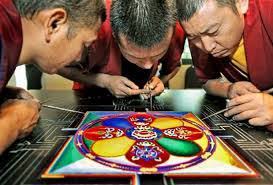
Google Image I was watching a documentary recently that showed Tibetan monks displaying their incredible talent in creating sand art. Their creations, called Mandalas, are made from white stones the monks crush and grind. They mix that with naturally colored sands to make desired colors. The monks work in teams, meticulously arranging the sand in intricate designs that form geometrically perfect and breathtakingly beautiful art, much of it depicting Buddhist deities. It takes weeks to finish them, but once finished, the art is ritualistically destroyed. “Huh? How can they work so hard to create such beauty then destroy it?” Because the whole process is meant to be a ritual symbolizing the tentativeness of life, something that we in the western world desperately try to ignore. An Illusion Oh, we may attend a funeral now and then where we can’t ignore what awaits us all, but by and large, society does all it can to provide the illusion that the world, and all that is in...

Changes of Heart: An Iraq War Veteran’s Faith Story

Image
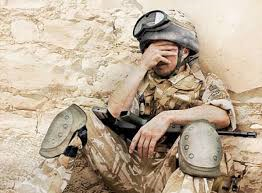
Google Image Among its best-read stories of 2018, America Magazine lists “Deployment to Iraq Changed my View of God, Country and Humankind. So Did Coming Home” by Phil Klay. Klay is a U.S. Marine Corps veteran of the Iraq War and the author of the short story collection Redeployment, which won the 2014 National Book Award for Fiction. In 2018 he received the George W. Hunt, S. J., Prize for Journalism, Arts & Letters. I read his story with the readers of this blog in mind. Though few of us have experienced the trauma of war, Klay appears to have struggled with faith problems shared by many who are searching for God. He started from the position of a practicing, but doubt-filled, Catholic. “Faith, for me, has always been a place to register a sense of doubt, of powerlessness, of inadequacy and uncertainty about my place in the world and how I am supposed to live,” Klay writes. Facing Human Frailty “You kneel before a crucifix. Before a broken, tortured and humilia...

Loving, and Hating, Christmas

Image
Google Image Last year, I wrote an opinion piece entitled, “Why Christians Should Hate Christmas.” It was published in the online edition of the National Catholic Reporter and elicited a bit of attention, even resulting in a telephone interview for the publication’s podcast. But on some level, I regret having written it. The point of the article was that Christmas has become so commercialized, so estranged from its meaning, so inimical to Christian values, that it’s unredeemable. I mentioned that if I had the power, I would change the Christian celebration of Christmas from Dec. 25 to some other date, abandoning Dec. 25 to the buyers and sellers. That last part may still not be a bad idea, but whenever it is held, Christmas itself is a beautiful celebration. The allegorical stories of Jesus’ birth capture essential lessons for anybody searching for God. The Value of Humility Among the most powerful of its lessons is the value of humility. God – who ...