Posts

Who Is Oscar Romero and Why Should We Care?  

Image
Google Image I recall my surprise when I first went to El Salvador and at community or church events saw huge photos of Che Guevara next to ones of similar size of Oscar Romero. Guevara was an Argentinian doctor who joined the Cuban revolution. He later tried to start a revolution of his own in Bolivia and was killed in 1967 by the Bolivian military. He became a symbol of armed revolution in Latin America and much of the world, his face appearing on the front of millions of t-shirts. Romero was the Archbishop of San Salvador, the capital of El Salvador. He was a champion of the Salvadoran poor and defender of human rights against a brutal government, not an advocate of violence. Nonetheless, he was assassinated in 1980 while celebrating Mass by elements of the Salvadoran military. The shock was seeing those two, a militaristic revolutionary and a Catholic member of the hierarchy, side-by-side. The Catholic hierarchy is not known for being revolutionary. To many minds, ...
A Comeback for Religion?

Image
Google Image Every once in a while, you hear or read something completely unexpected. That was the case recently when I read in America Magazine a story about a resident of Paris saying that much to his surprise, Catholic churches in France – among the most secular societies on earth – are filling up again. At first, Pascal-Emmanuel Gobry thought it was a phenomenon at the parish he attended, where if he was less than five minutes early for Mass he often found himself having to “step over people sitting on the floor” on his way to an overflow room. But, he writes, Mass “is packed in most parishes in Paris. This is also true in Lyon, the second biggest city in the country.” This is “in a nation where 53 percent of citizens (according to past polls) identify as Catholic but only five percent regularly attend Mass.” Of course, his "packed -church observation is anecdotal. Gobry cites no studies and couples this perception with the increase in the num...

The Most Important Question

Image
Google Image It was an erratic journey for Francis Collins, the famous geneticist who heads the National Institutes of Health, not ed for his discoveries of disease genes and leadership of the Human Genome Project. Growing up in a family indifferent to God and religion, he proclaimed himself an agnostic, then an atheist. Unlike other scientists, however, his research brought him closer to belief in God. “I was astounded by the elegance of the human DNA code,” he wrote in his book, ‘The Language of God,’ “and the multiple consequences of those rare careless moments of its copying mechanism.” He was compelled to ask himself, “Could there be a more important question in all of human existence than ‘Is there a God?’” Constructs of a School Boy He eventually answered that question in the affirmative, deciding that “all of my constructs against the possibility of faith were those of a schoolboy.” One of the constant themes of this blog is that there is no inherent conf...

Life’s Blue-Light Special

Image
Google Image My sister, Carolyn, likes to tell this story about me when I was a newly-married householder, but she may not remember it as I do. She was visiting as my wife, Amparo, and I were trying to furnish our $120-a-month apartment in a rural Iowa town where I had landed my first newspaper job. I was still in re-entry mode after over three years in rural Bolivia, where near our house in LaPaz, I saw people competing with dogs for scraps at garbage piles. I hadn’t become accustomed to what I saw as my country’s radical consumerism. We had gone to the K-Mart in a larger, nearby town, a store that I saw as perfectly representing consumerism. With its garish overhead fluorescent lights and ever-present, non-descript canned music, it had millions of products. I felt confused, detached and a bit angry. To be honest, I may not have been too happy about the whole idea of “going shopping,” not one of my favorite pastimes. But the K-Mart experience I found to be especially anno...

Why Many Young Catholics Stay in the Church

Image
Google Image Sophia was 25 years old when she was interviewed for the book, “Young Adult Catholics, Religion in the Culture of Choice” by Dean Hoge et al, a book to which I’ve referred often in these blogs.   “…I think I’m at a point where I think religion is more about spirituality and my own prayers and thoughts,” she said, “and I don’t necessarily have to actually go to Mass or be Catholic to be spiritual.” I must once again ask tolerance of my readers who are not Catholic because this blog is, even more than usual, written from the Catholic perspective. Still, a lot here would apply to people of any, or no, faith. Not For Lack of Faith? I’m returning to the subject of the flight from religion among young people because of a recent article in the National Catholic Reporter called “A Church to Believe In.” The subtitle is, “Young adults are leaving Catholic parishes, but not for lack of faith.” The article refers to various surveys that find that young Cat...

Skepticism about Skeptical Faith?

Image
Google Image Somewhere in my formal education, I learned the importance of critical thinking. I believe it was in high school, taught by priests, but I know I already had an idea about it in elementary school, taught by nuns. I never felt coerced to believe anything, and I recall challenging the nuns and priests throughout my years in school – including the priests who taught me in the seminary. Many of them weren’t happy about it, but there were never any dire consequences. Am I saying that I wasn’t influenced by my teachers and the faith that I inherited from my parents? Of course I was. But everybody has to try to make objective judgments about what they’ve been taught, heard and seen. Usually, that’s done incrementally during one’s life.   “Critical thinking” is usually thought of as a quality of science and scientists, not religious people. But I don’t quite see it that way. Scientists are also products of their backgrounds and upbringing and the influences of the...

Saying No to the Sense of Entitlement

Image
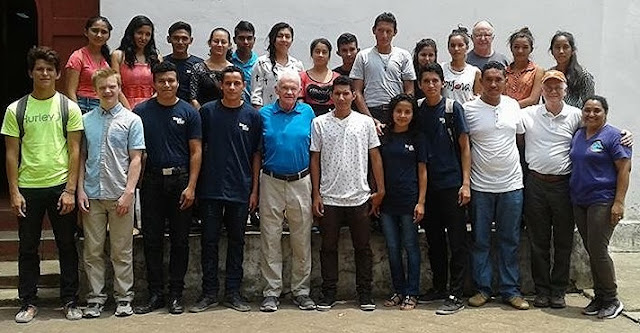
Scholarship Students with Assumption Parish Delegation We huffed and puffed climbing the steep path up a scruffy mountain, over orange to watermelon-sized rocks and the big tree roots protruding between them. It was hot, and the sweat was starting to drip from all the usual places. After about 20 minutes, we arrived where Salvador, a 20-year old who is only in his second year of high school, lives with an unmarried older brother. Only out of respect can you call it a “house.” It’s square with four corrugated metal walls and a roof of the same material – not the best for a humid climate with temperatures that are nearly always over 90 degrees. It has one room furnished with two neatly-made beds. The floor is of packed dirt. It has electricity, as evidenced by the single bulb hanging from the ceiling, but no plumbing. There is no apparent outdoor latrine. A hundred yards or so above Salvador’s house is that of his parents, who live with two daughters. The house is similar ...